A UX designer steps outside the brief to build a B2B go-to-market strategy from scratch — using the same systems thinking that drives good product work.
The challenge
OREL IT — a tech company offering AI, Cloud, and Security services — needed a coherent growth strategy. Sidath stepped in alongside marketing specialist Kayen Akeel to build a 9-month go-to-market roadmap, with no marketing background and no template to follow.
The core insight
You cannot effectively market what your organisation doesn't fully understand internally. The entire strategy was built inside-out — internal clarity first, external campaigns second.
The framework
Internal survey to audit what employees actually know about OREL IT's offerings
Insight-driven service positioning — lead with what you can genuinely win
Resource alignment — only promote what can be delivered
Human enablement — align sales and marketing before campaigns launch
Go-to-market execution — campaigns built on the foundation above
Scale and authority — thought leadership and whitepapers as the pipeline matures
Campaign strategy
One master line — “Transform Your Business with Smarter Technology” — anchors three service voices across AI, Cloud, and Security. Four content pillars (Clarity in Complexity, Real Business Impact, Trust & Partnership, Future-Ready Enterprises) structure every piece of content across the buyer journey.
9-month roadmap
Months 1–3: Foundation and awareness — brand clarity before lead generation
Months 3–9: Lead generation — LinkedIn, Meta, WhatsApp, Google campaigns
Months 6–9: Scale and authority — case studies, whitepapers, CEO thought leadership
Early results
First qualified lead generated through strategic understanding — before any paid campaign ran
Jira-based lead tracking workflow implemented and live with the sales team
Marketing and sales aligned as one integrated system from day one
Key takeaway
Systems thinking transfers across disciplines. The instinct to understand the full system before designing any part of it — the core of good UX — produced a stronger marketing strategy than starting with tactics would have.
Aligning product marketing & growth
A Go-to-Market Strategy Case Study
Designing a structured marketing system by aligning product, teams, and execution for sustainable growth.
A full marketing strategy for OREL IT — covering positioning, messaging, campaign structure, and a 9 month execution roadmap. Built outside my comfort zone, in close collaboration with Kayen Akeel.
"
This was not in my job description. I'm a UX guy — I think in flows, wireframes, and user research. Marketing strategy lives in a different headspace entirely. But when my company needed direction, I stepped in and figured it out.
— The honest starting point of this project
01 - Context
The situation at OREL IT
OREL IT offers enterprise technology services across AI, Cloud, and Cybersecurity — a capable team with strong technical depth. But the company lacked a structured approach to how it communicated those services to the market. There was no unified positioning, no messaging framework, and no sequenced plan for turning capabilities into leads.
Marketing was happening reactively — without strategic direction tying the pieces together. Something had to change before the company could scale its growth engine properly.
No unified positioning
Services existed but lacked a consistent story that could be taken to market with confidence and clarity
Inconsistent messaging
Different teams described the company's value differently, creating confusion both internally and externally
No lead generation system
No structured digital pipeline for generating and qualifying leads — efforts were scattered across channels
Reactive, not strategic
Campaigns responded to moments rather than being driven by a sequenced, insight-led strategic plan
02 - My role
A UX perspective on a marketing problem
I'm not a marketer. But the core skills of UX work — understanding systems, clarifying communication, mapping flows from user need to outcome — translated more directly than I expected. I approached this the same way I'd approach a complex product problem: define the real issue before designing the solution.
Working alongside Kayen Akeel, who brought deep marketing expertise in campaign mechanics and channel strategy, I contributed the structure, synthesis, and systems logic. My job was to take a messy, undefined problem and give it shape — a clear sequence of thinking that the whole team could act on.
"
This was a genuine collaboration, not a solo project. Kayen Akeel grounded the strategy in real marketing fundamentals — lead generation, channel selection, campaign sequencing. I brought the ability to make complex thinking legible, and a designer's instinct for what communicates and what doesn't. The result was stronger for both perspectives being present
03 - The framework
Inside-out: internal clarity before external growth
The central insight driving the entire roadmap: you cannot effectively market what you don't fully understand internally. Before any campaign runs, the organization needs alignment on what it offers, what it can deliver, and how to talk about it.
The roadmap starts with a structured internal survey across all employees — assessing knowledge of key offerings, ability to communicate value propositions, and clarity on target customers. Survey results, benchmarked against market data, then drive positioning decisions.
01
Internal survey + knowledge audit
Assess what employees actually know about OREL IT's offerings across AI, Cloud, and Security — and their ability to articulate value propositions to different customer types
02
Insight-driven service positioning
Use survey data — benchmarked against market and customer insights — to identify which services to lead with. Not everything: the ones OREL IT can genuinely win with
03
Resource alignment
Match prioritized services against actual delivery capacity. Only promote what can be fulfilled — avoiding over-promising and the operational breakdown that follows
04
Human enablement
Train internal teams on messaging and service clarity. Align sales and marketing. Define clear ownership of every lead channel — hotline, website, social — so nothing falls through
05
Go-to-market execution
Only after internal clarity is established do campaigns begin. Brand positioning, messaging frameworks, and lead generation all flow from the foundation built in steps 1–4
06
Scale + authority
As the pipeline matures, expand reach through thought leadership, whitepapers, and CEO content — building market authority alongside lead volume
04 - Campaign messaging
One master line, three service voices
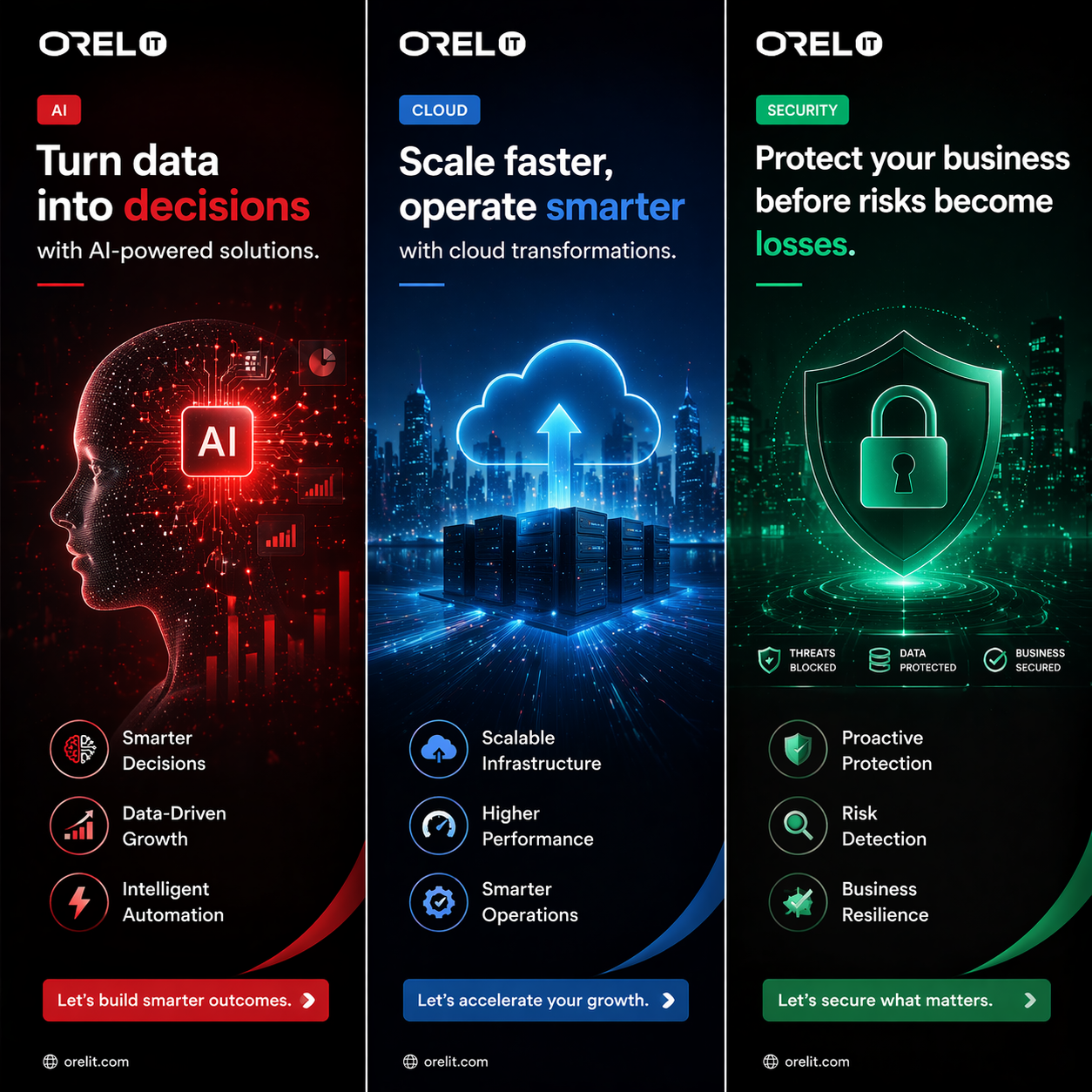
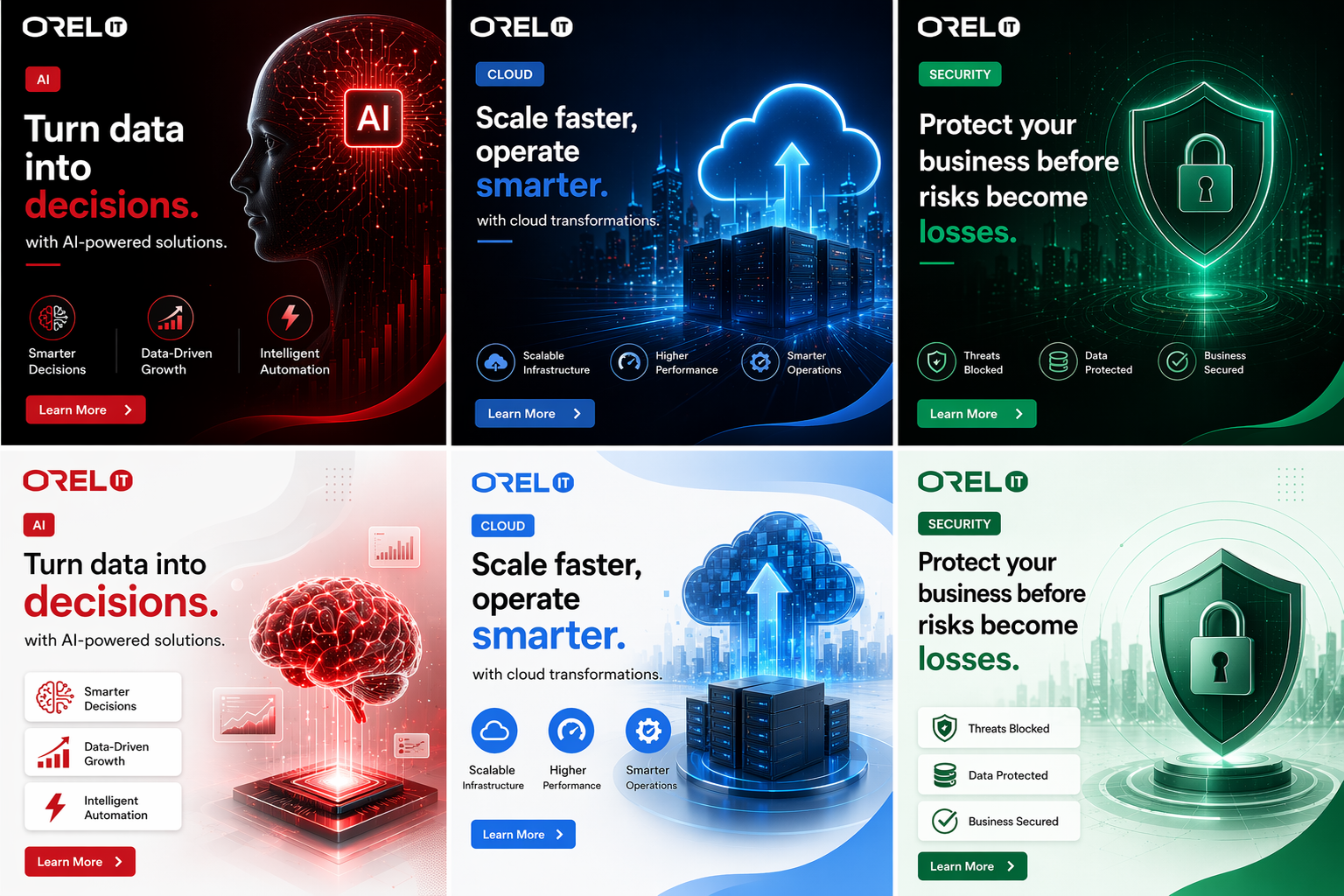
The main campaign line — "Transform Your Business with Smarter Technology" — anchors everything. Under it, each service area carries its own message that speaks directly to the buyer's problem rather than describing the technology.
AI
" Turn data into decisions with AI-powered solutions "
Cloud
" Scale faster, operate smarter with cloud transformation "
Security
" Protect your business before risks become losses "
Campaign ad mockups across AI, Cloud, and Security — vertical format for social channels
Horizontal format variants showing both dark-theme and light-theme executions across all three service lines
05 - Creative pillars
Four content pillars for a coherent brand voice
Rather than posting randomly across channels, the roadmap establishes four creative pillars — each serving a different audience need and stage of the buyer journey.
Every piece of content maps to one of these pillars, ensuring the brand speaks with a consistent and purposeful voice over time.
Pillar 1
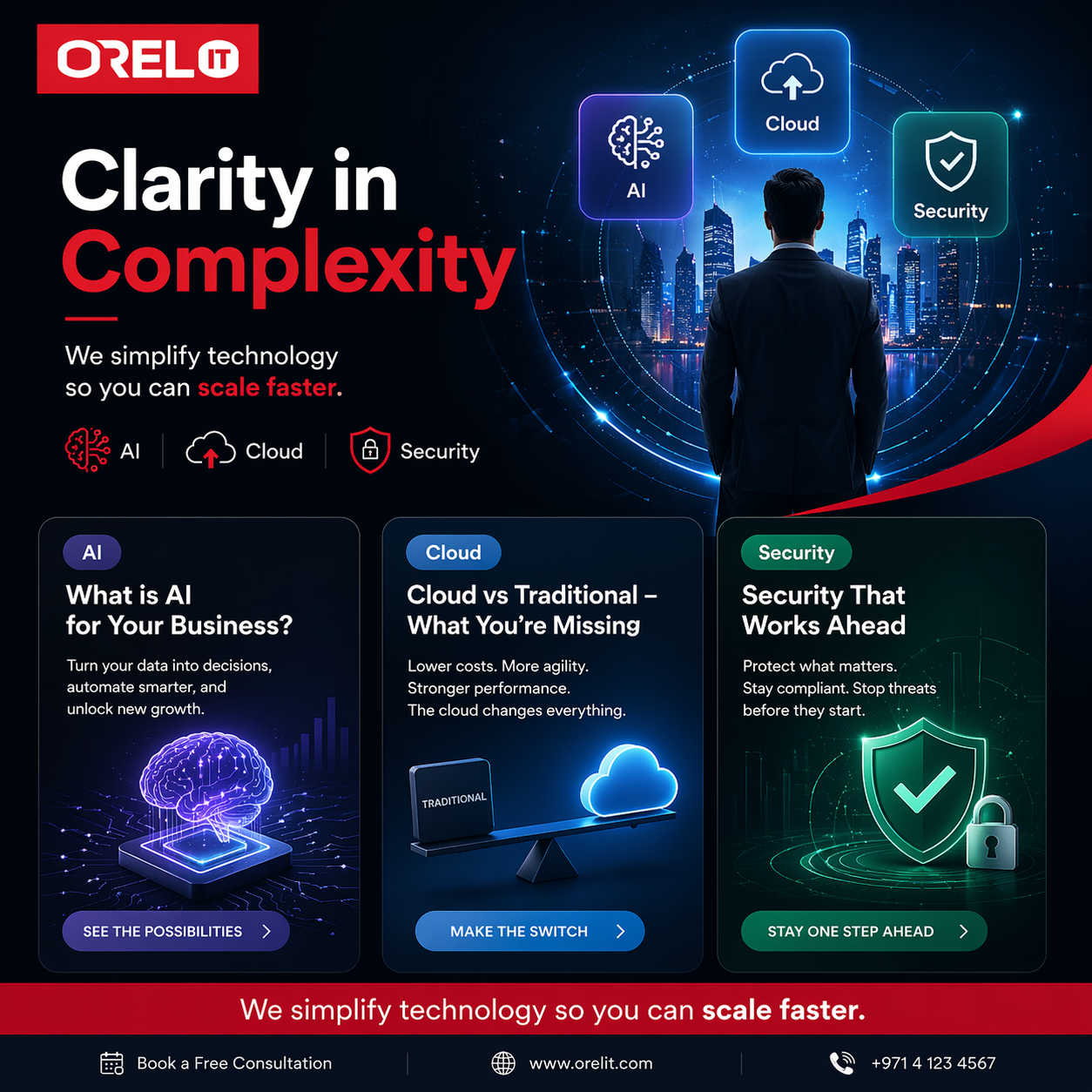
Clarity in complexity
"We simplify technology so you can scale faster"
Educational content · Short videos · Carousels
Pillar 2
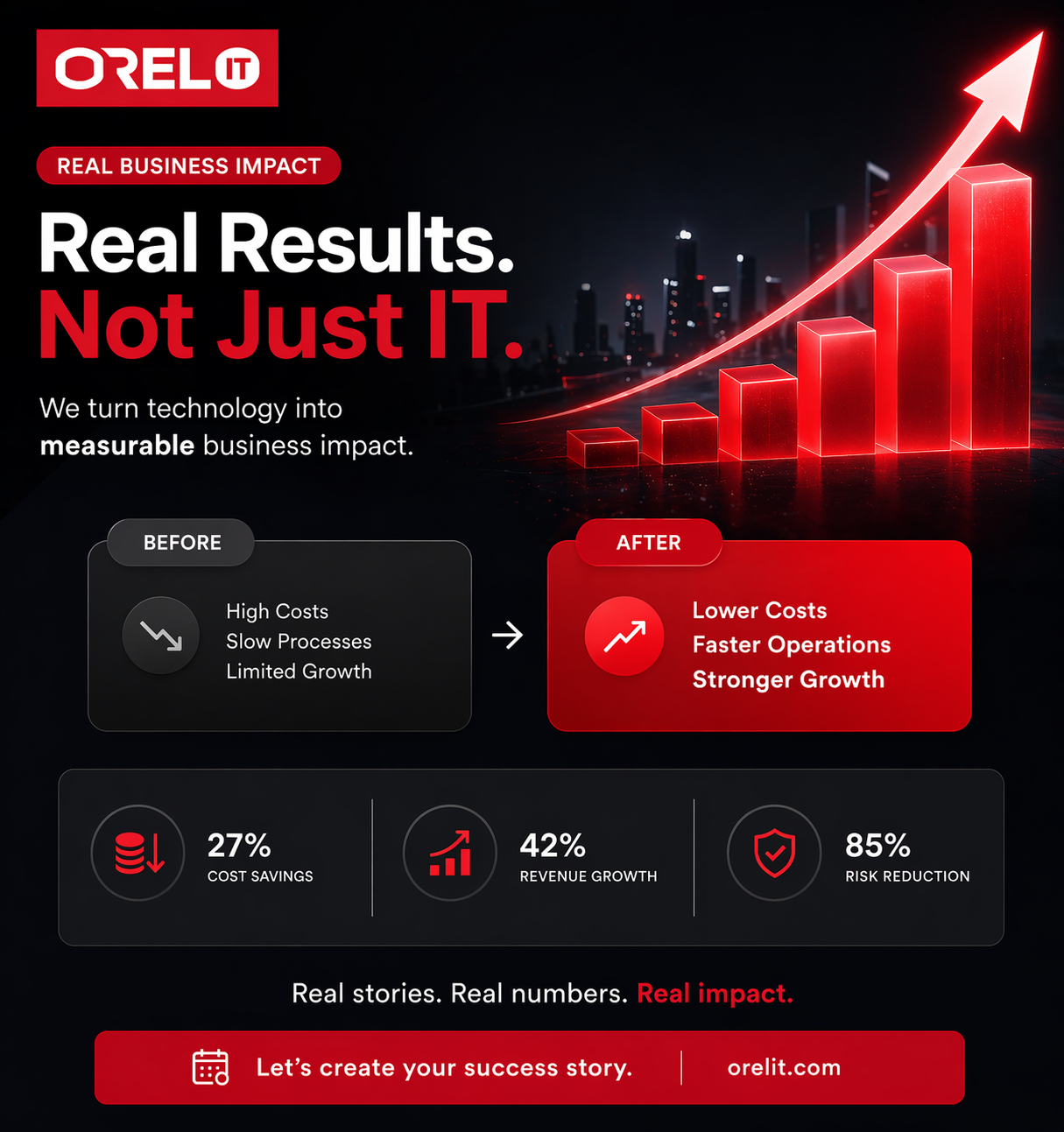
Real business impact
"Measurable business results"
Case studies · Before/after results · ROI storytelling
Pillar 3
Trust & partnership
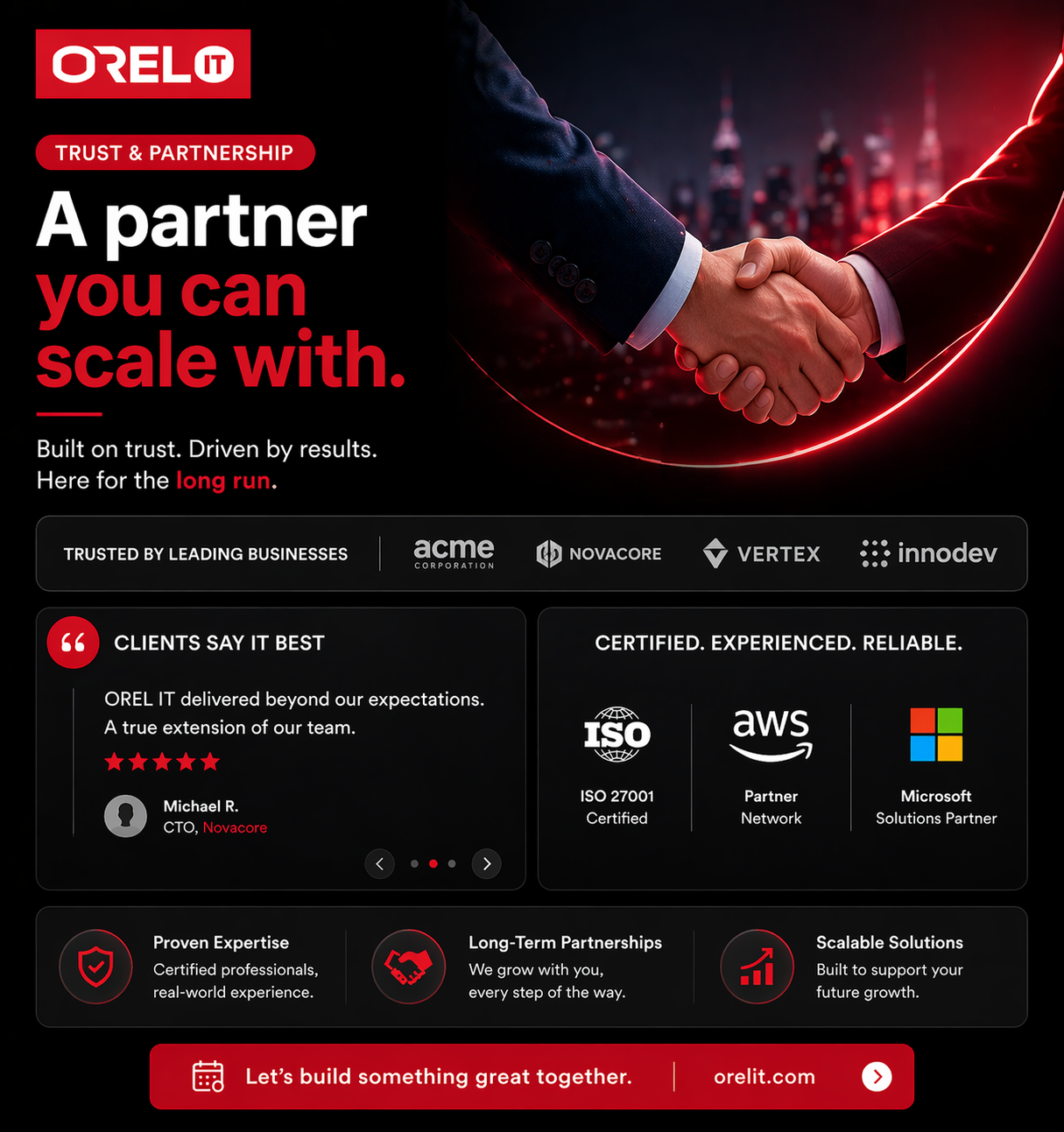
"A partner you can scale with"
Client testimonials · Certifications · Long partnerships
Pillar 4
Future-ready enterprises
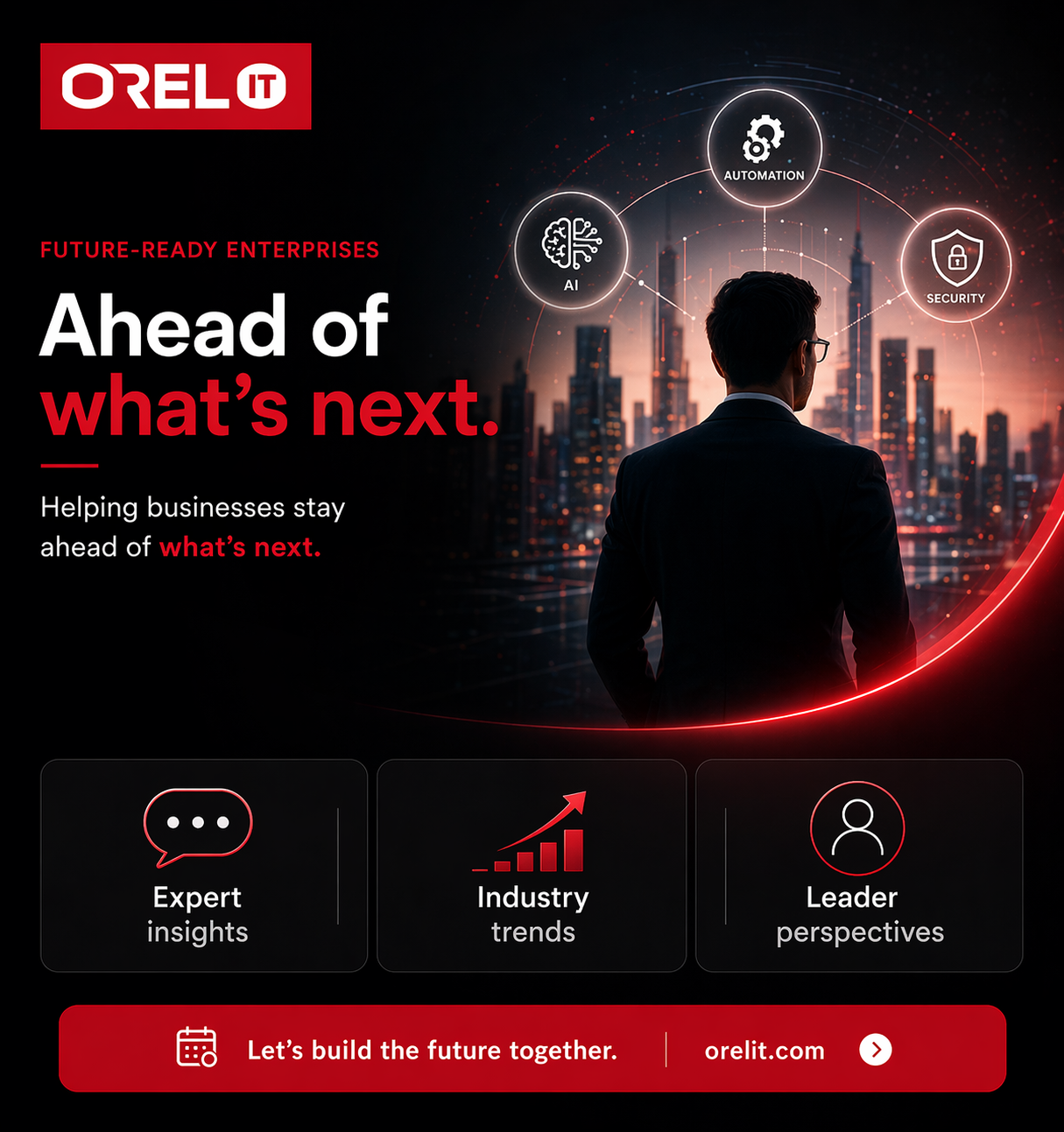
"Helping businesses stay ahead of what's next"
Thought leadership · CEO content · Podcasts
Pillar 1 execution: "Clarity in Complexity" — breaking down AI, Cloud, and Security for business audiences
Pillar 2 — Real business impact: before/after storytelling with measurable outcomes
Pillar 4 — Future-ready enterprises: vision and leadership positioning, thought leadership content
06 - Campaign structure
A sequenced 9-month execution roadmap
The roadmap phases execution deliberately — building awareness first, then activating lead generation once brand clarity is established, then scaling authority through premium content.
This avoids the common mistake of running conversion campaigns before the audience knows who you are.
LinkedIn + Meta lead formsWhatsApp / Google campaignsWebinar funnels
03
Month 6 - 9
Scale & Authority
Case study campaignsWhitepapersCEO thought leadership
Alongside the phased approach, a weekly content cadence ensures channels stay active throughout all phases — feeding both awareness and conversion simultaneously.
2x
Educational AI / Cloud / Security
1x
Case Study Result story
1x
Thought Leadership
1x
Conversion Post
5x
per week total
07 - Sales alignment
Marketing and sales as one system
One of the most overlooked parts of any marketing strategy is the handoff between marketing and sales. The roadmap treats these as a single integrated system rather than separate functions — ensuring that every lead generated has a clear owner, a defined follow-up process, and accountability for conversion.
This means CRM tracking from first touch, aligned messaging between what's advertised and what's pitched, and shared metrics that hold both teams accountable for the end result — not just their respective stages.
"
Marketing generates demand. Sales converts demand. Both must be aligned from Day 1 — not retrofitted after campaigns are already running. This principle shaped how we structured the entire go-to-market plan
08 · Impact
10 days of work. Early signals that matter
This roadmap is new. There are no vanity metrics to report, no polished before-and-after graph, and no inflated numbers. But honesty about where we are is part of good strategy work — and the early signals are real.
In the weeks since completing the roadmap, I began applying the positioning and messaging frameworks directly — getting deeply familiar with OREL IT's services, identifying the right audiences, and putting the strategy into practice myself. That hands-on approach produced the first tangible results.
"
A new lead generated — by understanding the company first.The roadmap's core principle is that internal clarity comes before external campaigns.
After spending time truly internalizing OREL IT's services, positioning, and ideal customers, I was able to identify and bring in the company's first lead attributable to this strategy — not through a paid campaign, but through understanding.
That's exactly what the framework was designed to enable.
"
Lead tracking process implemented in Jira.One of the roadmap's non-negotiables was that marketing and sales must function as one system. Through research and direct communication with the sales team, I was able to surface the gaps and make the case for a structured process.
That led the sales pillar to build and implement a lead tracking workflow in Jira — giving the team a single, accountable place to capture every incoming lead, track its status, and ensure proper follow-up. The process is live and in use.
My role was identifying the need and driving the conversation that made it happen.
"
Full strategy delivered in 10 working days.The complete roadmap — internal alignment logic, insight-driven positioning, resource framework, four creative pillars, campaign messaging, a 9-month phased execution plan, and sales alignment model — was researched, structured, designed, and presented in 10 days.
For a UX guy operating outside their primary domain, with no existing template to reference, this required first-principles thinking and disciplined, focused execution.
"
The roadmap is new and the full 9-month execution is only just beginning. Bigger results — pipeline volume, revenue influence, brand awareness growth — will come as the strategy matures and the team executes against it. What's meaningful right now is that the foundation is solid, the first signal is positive, and the infrastructure to track everything that follows is already in place.
— A note on where things stand
09 · Reflection
What stepping outside your role teaches you
This was genuinely hard. Not because the thinking was beyond me, but because I had no template to follow, no previous work to reference, and no certainty that what I was producing was right. That discomfort turned out to be one of the most productive states I've worked in.
Key takeaways
Systems thinking transfers across disciplines. The inside-out logic — internal clarity before external campaigns — is the same principle I apply in UX: understand the full system before designing any part of it. The domain was new. The thinking pattern wasn't.
Collaboration is a force multiplier, not a fallback. Working with Kayen wasn't about covering my weaknesses — it was about combining two genuinely different perspectives to produce something neither of us would have built alone.
Internal alignment is the most underrated part of marketing. The insight that shaped the entire roadmap — that you cannot market what you don't understand internally — is obvious in hindsight but almost never addressed first in practice.
Being a UX guy made me a better strategist here. The ability to simplify complexity, sequence information, and communicate clearly across audiences — those aren't marketing skills or design skills. They're thinking skills, and they apply everywhere.